The phrase, all that glitters is not gold, has a distinct meaning developed over time. Alain de Lille, a French monk, wrote in 1175, “Do not hold everything gold that shines like gold”. In The Canon’s Yeoman’s Tale, Chaucer told it thus: “But al thyng which that shyneth as the gold / Nis nat gold, as that I have herd it told”. Shakespeare embellished the phrase further in The Merchant of Venice. Time may have modified the phrase, but today, it holds a resonance as never before.
It’s a morality tale as old as time. One person achieves enormous wealth. Yet possessing all that money doesn’t create happiness. In fact, it creates quite the opposite.
Citizen Kane, Croesus, The Parable of the Rich Fool in the Gospel of Luke, the parables held in the Hindu ‘Manusmriti’ scriptures which illustrate moral and ethical principles, the parables of the Garden and the Spider in the Quran…even Edgar Allan Poe’s The Fall of the House of Usher – each carries this echo embedded in its bones.
Less poetically, but no less powerfully:
Do remember, wealth is like manure. If you spread it around it helps things grow. If you hoard it and keep it all to yourself, it’s just a pile of sh*t.
Wealth hoarding has become a feature of the tech, natural asset, and fintech/crypto billionaires. Yet even with all that money, these do not seem like happy people.
Bezos is envious that Musk is now far richer than he is. In terms of the wealth he controls, Bezos is closer to you and me than to trillionaire Musk.
Let that sink in.
Where did it all begin?
In Britain we saw socialised assets like water, railways, electricity, gas, telephony, housing, even oil, privatised through the 1980s and 1990s. To buy shares in these newly privatised assets, you had to have some liquid assets already.
Privatisation was rushed, and many of those involved in making it happen didn’t have the expertise to ensure robust post-privatisation regulation.
In the short-term following privatisation, governments had money to spend, and they did. This spending may not always have been directed very well, but there was some support for remaining socialised systems of health, social care, and education.
Less nobly, the dividend was also used to keep communities dependent on handouts from the state. For example, where employed in low waged jobs, those communities required ‘top-up’ benefits to achieve a living wage.
So, here we are
With the dissipation of the dividends from privatisation, and the increasing demands from the race to the bottom of the wage spiral, governments are finding themselves between a rock and a hard place.
So, in the interests of ensuring some form of stability UK Governments spent vast sums on advisors from the major consultancy firms to create a series of ever more costly ways to shift blame off the balance sheet. The Public Finance Initiative (PFI) by which private money pays upfront investment costs and then charges this back at great interest and the Post Office Scandal are just two well known examples.
It all reached an unholy crescendo through the Covid 19 emergency in 2020/2021 when any pretence to process was abandoned and cash fell from the magic money tree into the hands of a fortunate few.
Wealth isn’t trickling down, it is funnelling up.
What we do about spiralling inequality? The systems which create inequality are powered up by technology, AI and vast processing power. The social disruption they cause can be engineered by social media algorithms and powerful demagogues to scapegoat communities. Nature gets even more degraded and exploited as the technology consumes its resources faster.
Has wealth extraction which played out ‘over there’ in 19th century empires come home to roost?
Yes. Here’s an example.
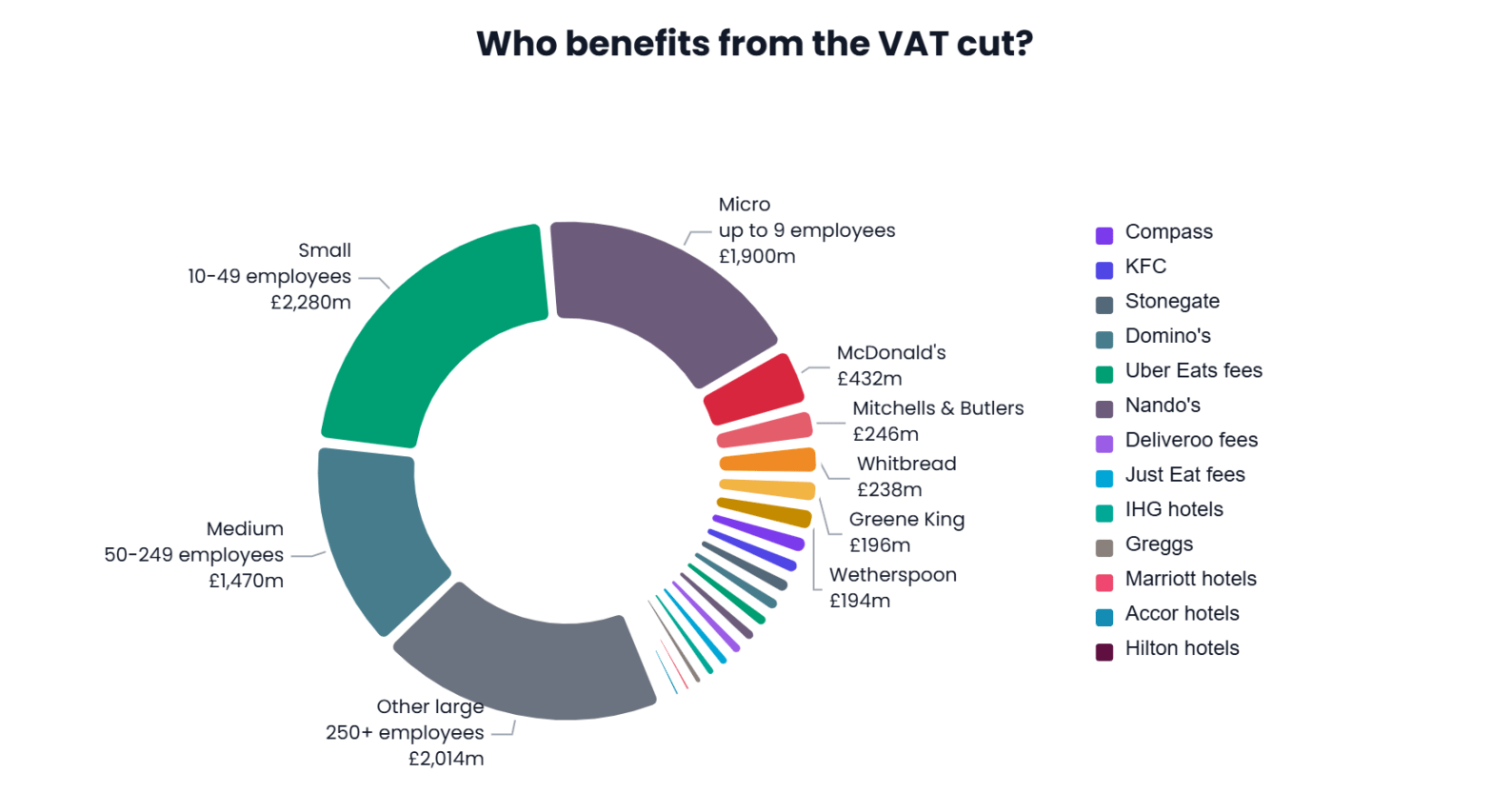
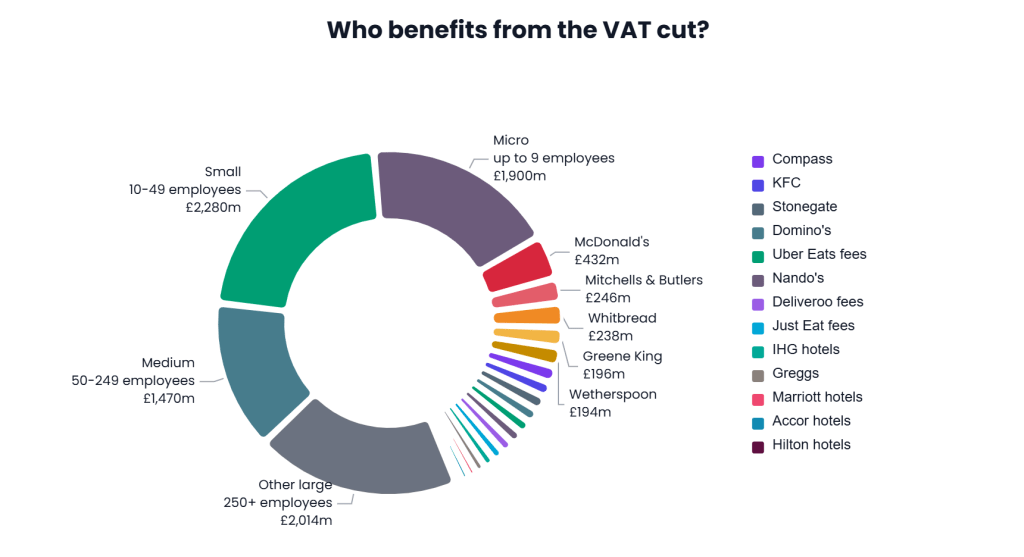
Today, the UK hospitality industry wants their VAT halved to 10%. Wage and raw material costs are going up they say, while cost of living impacts mean people are spending less. A cut like this will save our high streets.
Sounds reasonable doesn’t it?
Who benefits?
The smallest and most vulnerable businesses to whom this would make a massive difference do not benefit. These smaller businesses may not be able to manage the complex additional admin to claim the cut, and their scale is insufficient to generate much.
Consumers do not benefit either as prices will not fall by 10%.
So who benefits most? The answer is, those with the largest scale and control of markets. So, that’s McDonalds, Whitbread, Wetherspoon, Compass, Hilton, Greggs, Uber Eats, Just Eat, Nando’s etc.
The cold, hard reality is that this £12 billion will have to be paid for somehow.
Higher taxation elsewhere will be how the books get balanced. Tax efficiency is the preserve of the wealthy, as we know, so it won’t be them paying the additional tax.
The curious case of Compass Contract Services
Compass Contract Services control many of the hospitality assets on high streets and within services linked to the state; the NHS, Defence, Central and Local Government, Education…you name it. Compass is at the centre of it all and also owns numerous high street brands. A VAT cut favours them disproportionately well because of the sheer scale of their operation. It is Compass and their shareholders who will benefit most.
Welcome to 21st century capitalism.
Wealth isn’t trickling down, it is funnelling up, and you and I are paying for the already mega wealthy to get richer.
Preacher man don’t tell me heaven is under the earth,
— Bob Marley, Get Up, Stand Up
I know you don’t know what life is really worth,
It’s not all that glitter is gold,
Half the story has never been told,
So now you see the light,
Stand up for your right.

 Sanjit Chudha